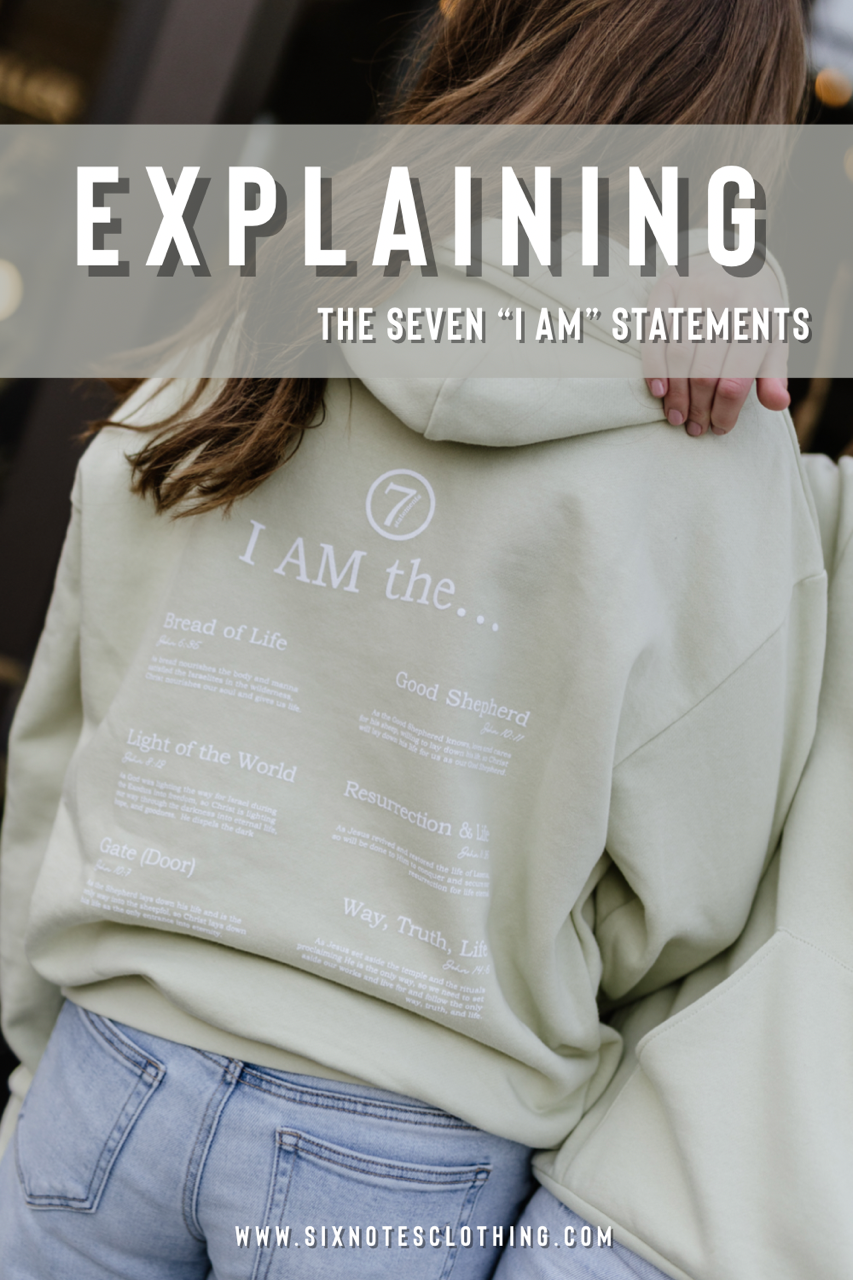

Explanation for the I AM Statements
For context: Back in Exodus 3 we learn about how God spoke to Moses through a burning bush. Moses is called by God to go back to Egypt and ask Pharoah to set his people free. (verse 8) Moses then goes through his questioning state and at one point asks God, who do I say sent me. God replies with “I Am.” (verse 14)
In the New Testament, we are introduced to John the disciple who is the author of the Gospel John. The Gospel of John is unlike the other three Gospels in the Bible, Matthew, Mark, and Luke. The Gospel John doesn’t give us a chronological order of Jesus' life or even share many of the teachings and miracles that the other Gospels use. He uses only events that help prove the holiness of Jesus, his deity. His book is centered around who Jesus is and to show readers that he is the son of God. He uses seven public signs (miracles) and seven metaphorical I AM statements that Jesus claims for Himself.
Seven I Am Statements:
I AM the bread of life - John 6:35
I AM the Light of the world - John 8:12
I AM the gate for the sheep - John 10:7
I AM the good shepherd - John 10:11
I AM the resurrection and the life - John 11:25
I AM the way, the truth and the life - John 14:6
I AM the true grapevine - John 15:11


Bread of Life
context: This statement happened the day after Jesus fed the 5,000. The people were looking for Jesus and Jesus accuses them that they want to be with him because he had fed them. He urges them to spend their energy seeking eternal life and not perishable things like food. He urges them to believe in the one God has sent, refering to himself. The people ask for another miracle like manna in the wilderness. Jesus then goes on to say that he is the bread of life and whoever come to me will never be hungry again.
Our take away: As bread nourishes the body and manna satisfied the Israelites in the wilderness, Christ nourishes our soul and gives us life.
Light of the world
context: Jesus was teaching in the temple courts right after the Feast of Tabernacles. He was just interrupted by a group of scribes and Pharisees (the dark) trying to trap Jesus but bringing him a woman caught in adultery. Jesus responds by stating “let those who have never sinned be the first to throw the first stone.” We know that Jesus was the only sinless person there and was unwilling to condemn her. He then continues his teaching by stating he is the Light of the World. According to BBB the light was an important symbol in the Feast of Tabernacles. During the feast, many emblems and ceremonies remember the pillar of fire that gave light to Israel during the Exodus. Not Jesus took this symbol and applied it to himself.
Our take away: As God was lighting the way for Israel during the Exodus into freedom, so Christ is lighting our way though the darkness into eternal life, hope, and goodness. He dispels the dark.
Gate for the Sheep
context: In chapter 9, Jesus heals a man borned blind. The Pharisees find out and start questioning and accusing the blind man and his family. The next two I am statements in chapter 10, Jesus is warning the crowd about wicked religious leaders and emphasizes His own good character (Tara Leigh-Cobble) He’s contrasting his heart for his people to the religious leaders of the day.
Spiritual leaders were often called shepherds. Jesus is explaining that not all are true shepherds. We are to watch for the thieves and robbers. When you look at the sheepfold of that time, shepherd would often sit at the door or the opening to guard the sheep. Jesus is saying, he is the only way in.
Our take away: As the Shepherd lays down his life and is the only way into the sheepfold, so Christ lays down His life as the only entrance into eternity.
Good Shepherd
context: Jesus is talking to the crowd who just saw the Pharisees get all huffy puffy because a wounded sheep was healed by the Good Shepherd. They treated the sheep with cruelty but Jesus protects the sheep. He goes on fruther to say that he knows his sheep and will lay down his life to protect his flock. Oh and by the way, if you are not in this group of sheep, Jesus wants to bring you as well. (verse 16)
Our take away: As the good shepherd knows, loves and cares for his sheep, willing to lay down his life, so Christ will lay down His life for us as our Good Shepherd.
Resurrection and the Life
context: Lazerus, a good friend of Jesus, became sick and died. Four days later, Jesus came. Before Jesus raises Lazerus from the dead he makes this I am statement to Martha, the sister of Lazerus. “I am the resurrection and the life. Anyone who believes in me will live, even after dying. Everyone who lives in me and believes in me will never die. Do you believe this, Martha?” She declares she believes he is the Messiah. Jesus walks to the tomb and commands Lazerus to come out… and he did.
Our take away: As Jesus revived and restored the life of Lazerus, so will be done to Him to conquer and secure our resurrection for life eternal.
The Way, the Truth, The Life
context: Jesus is in the Upper Room with his disciples. He has washed their feet and predicted Peter’s denial. The twelve are a little on edge as they listen to Jesus. Their hearts are troubled by what they are hearing Jesus say. He is going away to prepare of place for them. When everything is ready, I will come for you. (verse 2-3) But the disciples are afraid they won’t know the way. (verse 5) But Jesus reassures and says, I am the way, the truth and the life. He is the only way to God.
Our take away: As Jesus set aside the temple and the rituals proclaiming He is the only way, so we need to set aside our works and live for and follow the only way, truth, and life.
True Grapevine
context: Jesus continues to speak to his disciples in the Upper Room. According to BBB, He used the picture of the vine because there were grapevines everywhere in ancient Israel. Also, there was a large golden vine set as a prominent decoration on the front of the temple communicating the idea that Israel was God’s vine. This is a picture between the Lord and His people. The vine and the branch. The branch has complete dependence and need for a constant connection with the vine.
Our take away: As a grapevine has one vine that supports all its branches, so Christ is our one vine. When we are connected to that grapevine, we will bear much fruit.
advertisement
Pin it for later